
For decades, Boston’s aging public schools have been harming the health and education of our students and staff. Most of our school buildings do not have ventilation systems, air conditioning, or modern electric heating systems. These conditions make it harder for students to learn and teachers to teach all while putting Boston’s carbon reduction goals out of reach. It’s an education justice issue, a climate justice issue, and a racial justice issue.

Aliya, who attends the Lee Academy Pilot School in BPS. She’s holding a picture of WWI’s Battle of Verdun because it happened in 1916, the same year the LAPS was built over 100 years ago. This image is part of a series by BCAN member and BPS parent Mike Ritter. See the full post here, and Sign up here for a portrait with your school.
As BPS creates its facilities master plan (expected in the Fall of ‘23), it must finally make all its buildings worthy of the 21st century with at minimum state-of-the-art HVAC (Heating, Ventilation, and Air Conditioning) systems provided by electric heat pumps, Dedicated Outdoor Air Systems, and filters to clean indoor air. This would improve the health of students and staff, reduce Boston’s fossil fuel use dramatically, and provide cleaner neighborhood air.
Jump to:
Fact Sheet and Other Resources
Driving factors:
- It’s Necessary.
- It’s Responsible.
- It’s Smart.
- It’s Possible.
Necessary. BPS is by far the largest source of municipal emissions owning 11 million of Boston’s 16.5 million sq. ft of building space representing two thirds of municipal natural gas consumption as detailed in Boston’s Carbon Emissions report. Boston cannot lower its carbon emissions in line with the passed BERDO 2.0 ordinance without addressing how its school buildings are heated.
With Boston’s history of neglecting school buildings, redlining and segregation, it’s no surprise that our schools are dilapidated, lacking in basic infrastructure, and extremely energy inefficient, especially in Boston’s black and brown neighborhoods. Our communities deserve better!
We must build and retrofit school buildings that prioritize racial and economic equity and health and learning of students. This requires centering community control and transparency. And we’ll reduce emissions and pollution in the process.
Responsible. It may be expensive; but it’s the right use of taxpayer money. In their report, The Impact of School Facility Investments on Students and Homeowners: Evidence from Los Angeles, researchers Julien Lafortune and David Schönholzer detail student improvement in math and English, increased neighborhood property values with minimal displacement, and an estimated return of $1.6 for every school capital investment $1. If one considers health of the students and teachers and looks at a longer time horizon, the benefits far outweigh the costs. BPS grads could even be part of the crews constructing / retrofitting these 21st century BPS buildings.
Smart. “US K-12 school districts spend $8 billion each year on energy – more than they spend on computers and textbooks combined.” Pg. 15 Advanced Energy Retrofit Guide for K-12 Schools by the US Dept. of Energy. Heating and cooling school buildings with modern, efficient systems powered by more and more renewable energy could free up significant amounts of money for actual education. Continuing to run on fossil fuels is short term expensive, and long term devastating.
Possible. It can be done. Washington DC, a district comparable in size to Boston, is 2 years away from modernizing all its schools as detailed in Every Neighborhood, Every Child Brief 1 School Buildings by Boston Schools Fund. Here are some case studies from Mitsubishi and CMTA detailing successful renovations and new school buildings in Kansas, West Virginia, and New England among other places.
Mayor Wu’s Green New Deal for Boston Public Schools is a good first step, but it doesn’t mention district wide HVAC or net zero buildings. BPS must do more with the creativity and urgency required by the dilapidated state of its facilities and deliver state-of-the-art climate control technology to all school buildings. This can and must be the last generation of BPS students to ever cope with such schools.
Boston has the money, but does it have the will? What will Boston do with its AAA bond rating, overflowing property taxes, $5B ARPA money, IRA money, and $400M ESSER money? Boston prides itself on being the birthplace of American public education in the 1600s and in general on its reputation for educational excellence while leaving the majority of its own children in deplorable school buildings. This has been happening for decades as detailed in Death at an Early Age by Jonathan Kozol published in 1967 documenting among other things substandard buildings literally falling apart around the students. Neglecting school buildings is neglecting BPS students.
Campaign Win
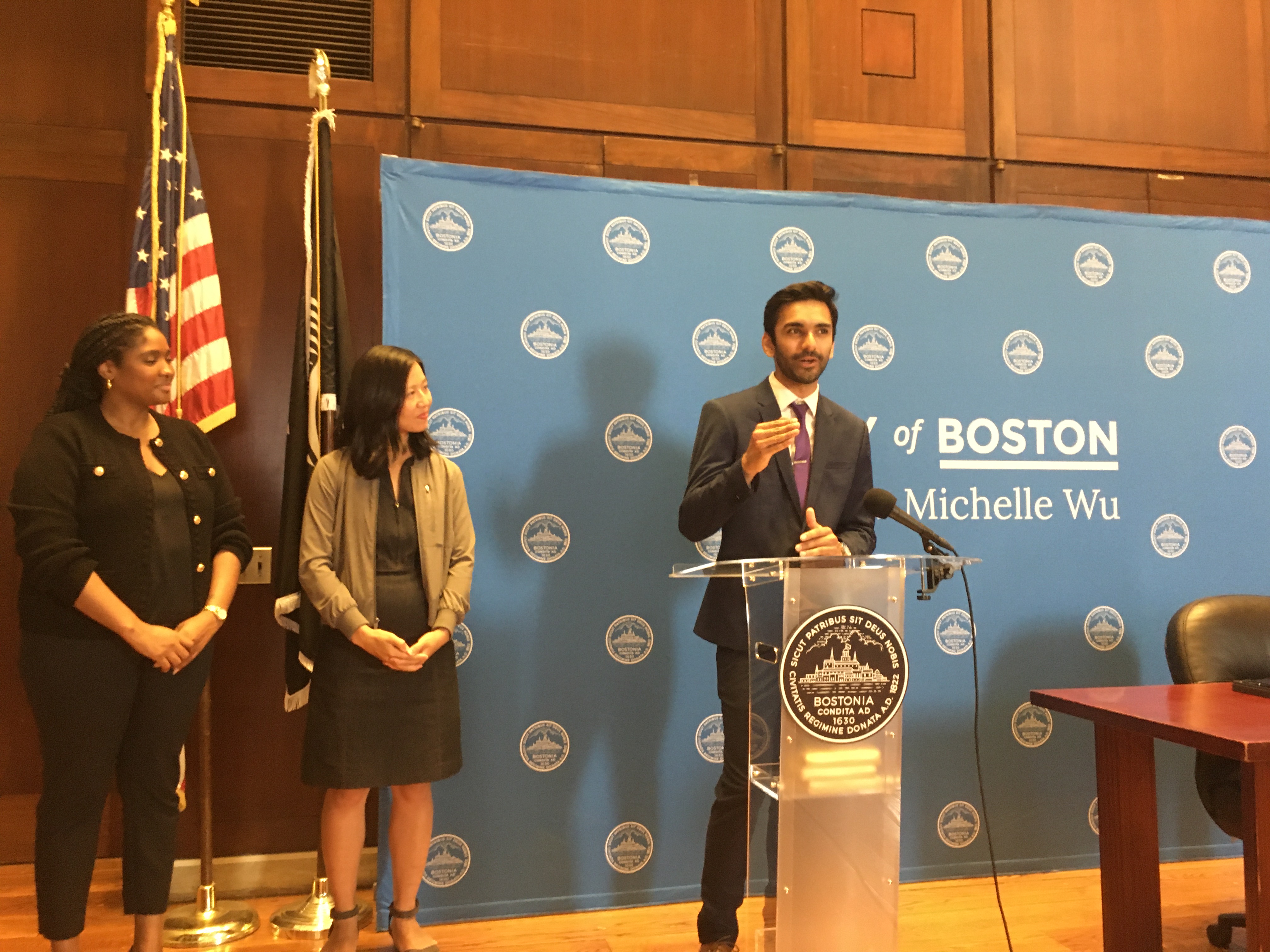
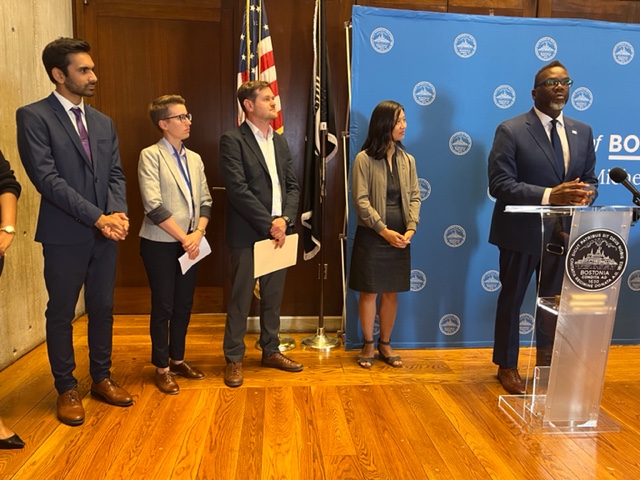
We celebrated the accomplishment of a major campaign goal. BCAN’s advocacy resulted in the passage of an Executive Order mandating every new construction and major renovation of a Boston Public School will be fossil fuel-free for the first time. This Executive Order applies to all municipal buildings, the majority of which are schools by square footage. Recognizing BCAN advocacy’s pivotal role, Boston Mayor Michelle Wu invited Executive Director Hessann Farooqi to speak at the signing ceremony and awarded him the signing pen at the ceremony’s conclusion. We could not be more thrilled with this policy’s passage.
Learning and Additional Resources
- Talking Points and Fact Sheet developed by BCAN and FamCOSa
- Time for Massachusetts to Make All Schools, Green, Healthy and Carbon Free – The74
- Resources of climate and K-12 from UndauntedK12, including the K-12 Climate Action Parent Advocacy Toolkit
 BCAN
BCAN 
You must be logged in to post a comment.